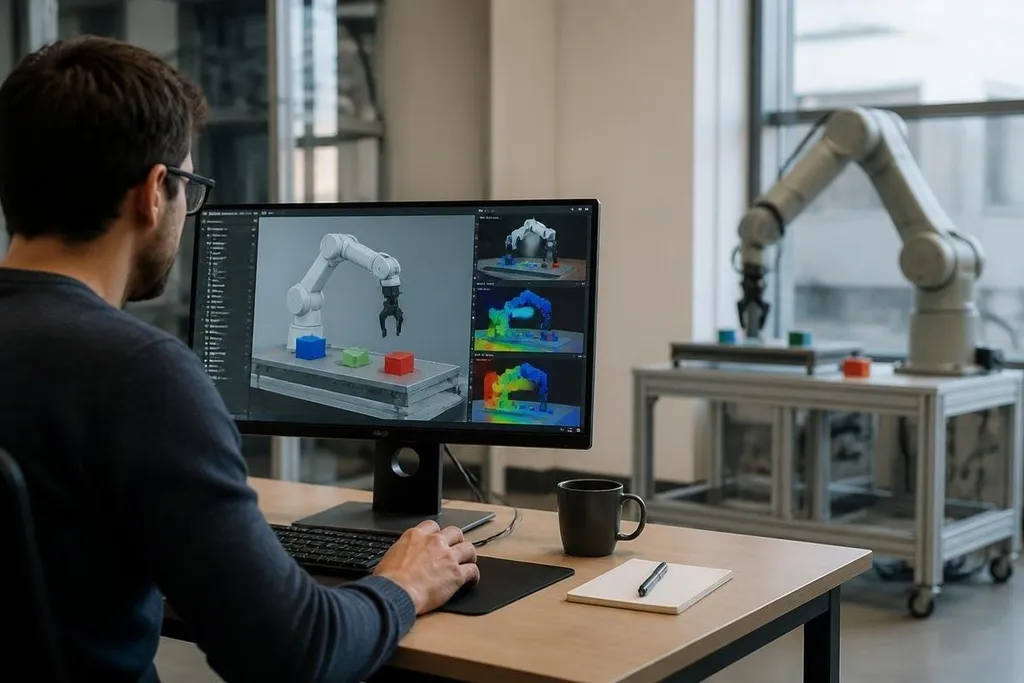
A robot can learn from images, joint angles, depth maps, and contact forces created inside a simulator. That gives its control software more practice before anyone puts a real arm, gripper, or mobile base on the factory floor.
For a robotics team, the value is practical: synthetic data can cover rare failures, reduce manual labeling, and test software against conditions that are hard to create with hardware alone.
- Simulation can produce labeled camera and sensor data on demand.
- Random changes in lighting, object position, and surface texture help expose weak points.
- Real hardware tests still decide if the system works outside the simulator.
What synthetic data contains
Software makes synthetic data rather than recording it from a physical robot. A simulator can place objects in a scene, move a virtual camera, and record the result with labels that would take much longer to add by hand.
Those labels might identify an object’s location, its edges, or the distance from the camera.
A simulation can also record the robot’s joint angles, motor commands, contact points, and whether a planned motion succeeds. Each item gives a learning system a clear target.
That target matters because a recorded image often needs human review before it can train a model. The simulator already knows what it placed in the scene. It can mark the object and its position as the scene runs, then produce another labeled case when the team changes the setup.
Why real data still leaves gaps
A robot may work well on common motions and still fail when a box shifts, a surface reflects light, or an object partly blocks another object. Those cases may be rare in a small test set, yet they can stop a task on the factory floor.
A team can create those cases on purpose with synthetic data. A method called domain randomization changes selected details between runs, such as camera angle, light level, object color, friction, or sensor noise. The robot sees many versions of the same task instead of one fixed scene.
This does not make the simulator a copy of the physical world. It gives the software more ways to meet the task, then leaves the hardware to prove that the learned behavior transfers.
The sim-to-real gap
The largest problem is the difference between a virtual robot and a real one. Motors have delay, gears have play, sensors have noise, and objects do not always behave like the physics model predicts.
A gripper that closes at the right speed in simulation may slip on a real part. A mobile robot may follow a clean virtual route but lose position when dust affects its camera or LiDAR. These failures come from details that the simulator did not model well enough.
Teams reduce this gap by adding real measurements to the training process. They can compare motor response, camera output, wheel motion, and contact behavior, then adjust the virtual model. The exact method depends on the task, and no simulator removes the need for physical tests.
A simulator can teach a gripper where to reach, but a loose cable or uneven part can change the result. Reporting from Robot24 can connect synthetic-data methods with robots tested in physical settings. That makes the next question practical: which tasks gain enough from virtual trials to reduce work on hardware?
Where the method earns its place
The method fits tasks with clear sensors, repeatable actions, and expensive or rare failures. It can help a vision system spot parts in changing light, give a grasping model more object poses, or test a mobile robot against different routes and obstacles.
The benefit grows when a team needs many labeled cases but has limited access to hardware. A virtual run can repeat a test without wearing a motor, breaking a part, or waiting for a technician to reset the scene.
Still, synthetic data can waste time if the task is poorly defined. More simulated images do not fix the wrong camera position, a weak reward signal, or a gripper that cannot reach the part in the first place. The data must match the decision the robot needs to make.
A practical check before you rely on it
Use this checklist before moving a model from simulation to a real robot:
- Name the sensor output the model will use, such as an RGB image, depth map, or force reading.
- List the physical details that can change the result, including friction, delay, lighting, and object weight.
- Compare simulated readings with measurements from the actual camera, motor, or gripper.
- Keep a small set of real test cases outside the training data.
- Record every failure by task, object, sensor condition, and robot motion.
- Set a physical pass rule before the first hardware run, such as successful picks across a fixed test set.
This approach is worth using when it adds cases the team cannot collect safely, cheaply, or often enough. I'd skip it when the simulator hides the very contact, timing, or sensor errors that decide whether the robot succeeds.
The next useful step is a measured comparison: run the same task in simulation and on the real robot, then count which failures appear in only one of them.